A garage door that feels heavier than it used to is one of the more useful symptoms a homeowner can notice, because it usually shows up before anything breaks outright. The door still opens and closes. It just seems to take more out of the opener, or the cycle sounds labored at the start, or you find yourself waiting a beat longer than you used to. On the Treasure Coast, where doors work hard year-round and storm season puts extra demand on the whole assembly, that change is worth paying attention to. This article explains what a heavy-feeling door points toward, which causes are certain and which are not, and what a homeowner can safely observe before calling a technician.
What the springs actually do
A garage door is heavy. The panels, frame, and hardware on a typical residential door add up to a load that no opener and no person should be lifting unaided. The springs—torsion springs on a shaft above the door, or extension springs along the sides on some older doors—are what counterbalance that weight. They are under tension when the door is down and release that tension as the door comes up, so the door travels through its cycle with roughly the same effort at the bottom as at the top.
When a spring loses tension, the counterbalance is no longer matched to the door. The door still moves, but the opener is now doing work the spring used to do. That is why a heavy-feeling door is often the first sign of a counterbalance problem rather than a door problem. A broken torsion spring cannot hold the door's weight at all, and a door with a snapped cable hangs at an angle—those are certainties. A spring that has simply weakened is a slower, quieter version of the same story.
What you can observe without touching anything
The safest way to gather information is to watch and listen during a normal cycle, with the garage empty and nothing in the door's path. You are not testing the door; you are noting how it behaves.
- The door feels heavier in normal use. If you notice the door taking more effort than it used to when you operate it the way you always have, or the opener sounds labored at the start, that is a real observation worth reporting.
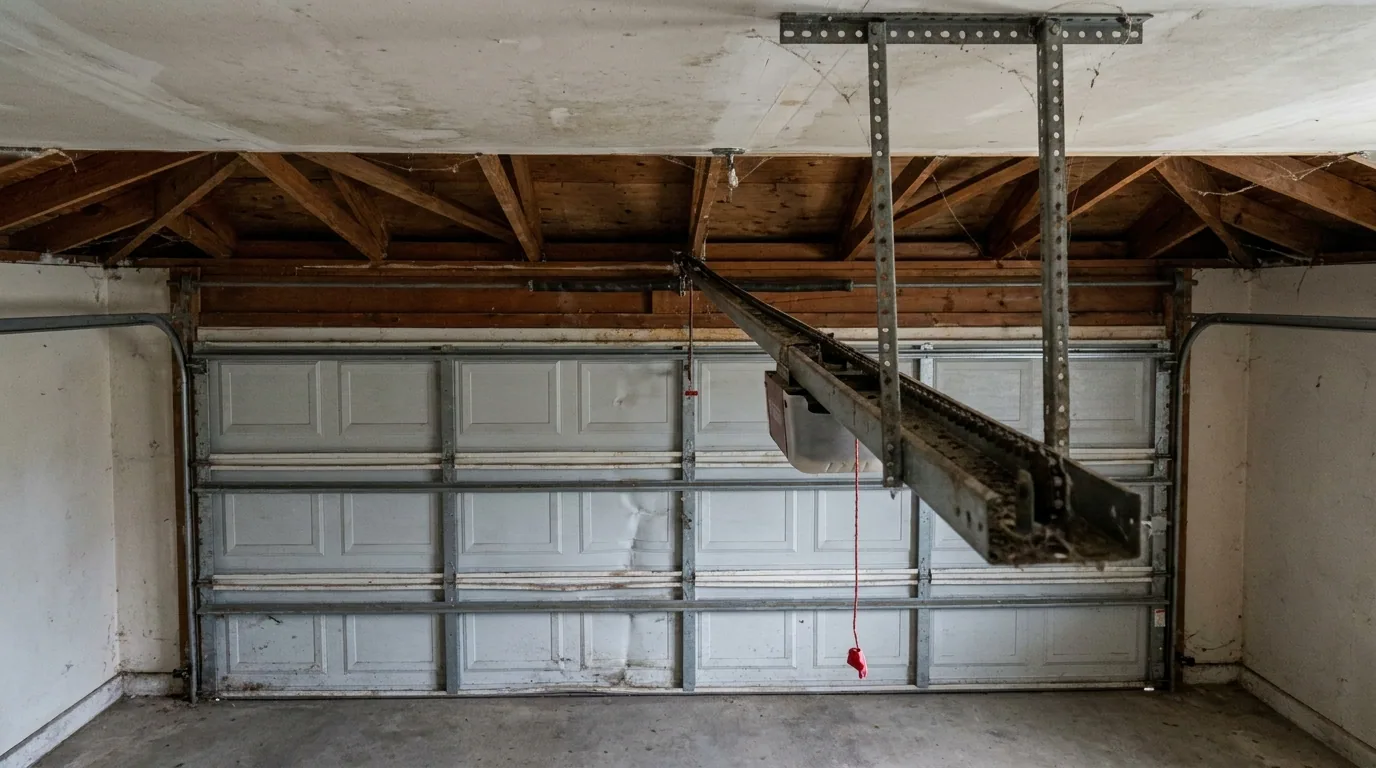
- The door sits crooked or has a gap along the top. A door that hangs at an angle when closed can mean a snapped cable, a broken spring, or a bent track. Those are three different repairs, and the technician's inspection separates them.
- A new noise at the start of a cycle. A bang, a squeal, or a grind can come from a roller, a hinge, a dry bearing, or the opener itself. The location and timing of the noise help narrow it down.
- The opener strains or the door moves unevenly. If the door starts, hesitates, and then continues, the opener may be compensating for a counterbalance problem.
What you should not do is lift the door by hand to judge its weight, test the balance yourself, or pull the emergency release and move the door. Those checks put you in contact with the spring and cable system, which is under tension and belongs to a technician. Describing that the door feels heavier when you use it normally is enough.
When the cause is certain, and when it is not
Some causes are mechanically certain. A broken torsion spring cannot hold the door's weight, full stop. A stripped opener gear lets the motor run without moving the door. A door with a snapped cable hangs at an angle. If you see any of those, the diagnosis is not in doubt—but the repair still requires a technician, because the parts involved are under load.
A heavy-feeling door with no visible break is a different situation. It can mean a spring has weakened, a cable has stretched or slipped, a roller or hinge is binding, or the track has shifted slightly out of alignment. Each of those produces a door that takes more effort, and each calls for a different repair. The technician's inspection—checking spring tension, cable condition, roller wear, and track alignment—is what tells them apart. Guessing at one cause and replacing that part is how homeowners end up paying twice.
Why the opener should not be the first suspect
When a door feels heavy, the instinct is often to blame the opener. Sometimes that is right—a failing motor or a worn drive can make a door feel sluggish. But an opener that is working correctly will still struggle against a door whose springs are not doing their job. Replacing the opener without addressing the counterbalance just puts a new motor in front of the same problem, and the new motor will wear faster for it.
This matters for small commercial property owners too. A commercial door that sees dozens of cycles a day will show a counterbalance problem sooner than a residential door, and the symptom is the same: the door feels heavier, the opener works harder, and the cycle gets slower. Addressing the counterbalance first is usually the right sequence.
What to do before the technician arrives
If the door is still operating, keep using it sparingly and note what you observe: when the heaviness started, whether it is worse at the bottom or the top of the cycle, any new noise, and whether the door sits level when closed. If the door has stopped moving entirely, leave it down and call for service rather than forcing it.
DoorCore Garage Doors serves homeowners and small commercial properties across the Treasure Coast, including Port St. Lucie, Fort Pierce, Stuart, Jensen Beach, Palm City, Hobe Sound, Vero Beach, and Sebastian. The company is licensed and insured, and emergency service is available. If your door feels heavier than it used to, call (561) 421-5760 or email DoorCoreFL@gmail.com to schedule a visit. A technician will inspect the springs, cables, rollers, and track, identify what is actually causing the change, and explain the repair before any work begins.