Most homeowners choose an opener by looking at the motor and ignoring the drive — the rail, belt, or chain that actually pulls the door. That is backwards. The motor supplies force, but the drive is what you hear every morning, what needs attention over the years, and what determines whether the opener is a good match for the door hanging above it. Belt-drive and chain-drive are the two most common arrangements on residential doors, and the difference between them is small in principle and noticeable in daily use. This article covers how each drive works, what each is good at, what a homeowner can safely observe, and where a technician's judgment matters.
What the drive actually does
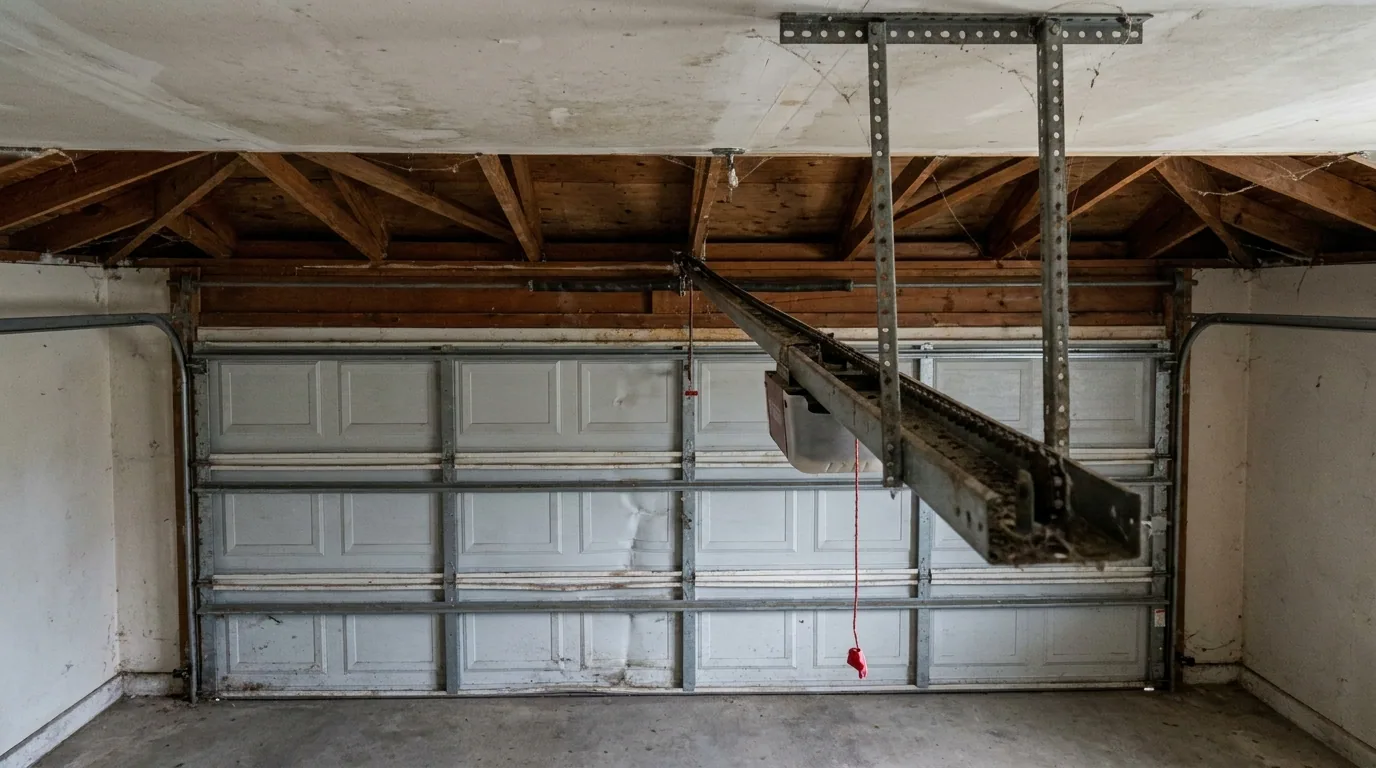
An opener is mounted to the ceiling above the door and connected to the door by a rail. Inside that rail, a carriage travels back and forth: the motor turns a sprocket or pulley at the head, and the carriage rides along the rail to push or pull the door. The drive is the link between the motor and the carriage.
A chain drive uses a metal chain looped around a sprocket, much like a bicycle chain. It is a proven arrangement, mechanically simple, and it tolerates a lot of use. It is also the louder of the two, because metal links running over a metal sprocket make noise.
A belt drive replaces the chain with a reinforced rubber belt running over pulleys. The belt absorbs much of the vibration and engagement noise the chain produces, so a belt-drive opener is generally quieter in operation. Belts do not need the same periodic lubrication a chain does, but they are a wear item and can stretch or fray over time.
Noise: what you hear, and what it means
Noise is the reason most people ask about belts in the first place. If the garage sits under a bedroom, shares a wall with a living space, or opens onto a street where a late arrival matters, a belt drive is usually the easier neighbor. On a small commercial property — an office with an attached bay, a workshop near a customer counter — the same logic applies.
But "noisy" is not automatically a drive problem, and this is where homeowners get steered wrong. A door that has become louder over time can be telling you several different things:
- Rollers and hinges. Worn steel rollers, or hinges that have dried out, rattle and squeal as the door travels.
- The drive itself. A chain that has lost lubrication or gone slack will slap and growl inside the rail; a belt that has stiffened or frayed will thump.
- The door's own hardware. Loose brackets, a track that has shifted, or panels that have worked slightly out of alignment can all add noise.
A useful way to separate them: listen to when the noise happens. A rattle that rises and falls with the door's travel points toward the door's rollers and hinges. A sound that is concentrated at the start and end of the cycle, when the motor engages and disengages, points toward the drive or the opener's mounting. That is a starting observation, not a diagnosis — a technician can confirm which part is responsible by inspecting the assembly.
Maintenance and wear over the years
A chain drive asks for occasional lubrication along the chain to keep it quiet and to slow wear on the links and sprocket. Skip it for long enough and the chain can run dry, stretch, and eventually jump or break. A belt drive asks less of the homeowner in routine care, but the belt is still a wear item: heat, age, and load can cause it to stretch, crack, or fray. Either drive can also lose tension at its adjustment point, which shows up as a door that hesitates or a drive that slaps inside the rail.
In either case, the drive is not something to open up and adjust yourself. The rail is under tension from the door's springs through the carriage, and the connection between the opener and the door is part of a load path. If the drive is slack, frayed, or broken, that is technician work.
Matching the drive to the door and the building
The drive should suit the door it is lifting. A heavy door — a tall residential door, an insulated door, or a commercial sectional door — puts more load on the opener, and the opener's capacity has to match. A belt drive that is right for a standard single-car door may not be the right choice for a wide, heavy door, and a chain drive on a light door in a quiet room may be more noise than necessary.
Two practical questions narrow it down:
- Where is the noise going to land? If the garage shares a wall or floor with rooms people use while the door runs, the quieter drive is worth considering. If the garage is detached or noise does not carry, the difference matters less.
- How is the door used? A door that cycles many times a day — a small commercial bay, a workshop — puts more wear on the drive. A door that opens once in the morning and once at night leads a gentler life.
What a homeowner can safely check from outside the door with the garage empty is the door's behavior: whether it sits crooked, whether there is a gap along the top when closed, whether it feels heavier in normal use, or whether a new noise has appeared at the start of a cycle. Those observations help a technician match the opener to the door, and they sometimes reveal that the door's hardware needs attention before a new opener is worth considering.
When to call a technician
Choosing a drive is a decision; installing or repairing one is not a homeowner task. The opener's rail, the carriage, the springs, and the cables are all part of the door's load path, and working on them without the right tools and training is how people get hurt. If the door is crooked, if the opener runs but the door does not move, if the drive is visibly slack or damaged, or if the door reverses before it reaches the floor, those are calls for a technician rather than a parts decision.
DoorCore Garage Doors serves homeowners and small commercial property owners across the Treasure Coast, including Port St. Lucie, Fort Pierce, Stuart, Jensen Beach, Palm City, Hobe Sound, Vero Beach, and Sebastian. The company is licensed and insured, handles both residential and commercial garage door repair and opener work, and can be reached at (561) 421-5760 or DoorCoreFL@gmail.com. Weekday hours are 7:00 AM to 7:00 PM, Saturday 8:00 AM to 5:00 PM, with emergency service available.