A garage door that scrapes, binds, or refuses to close all the way gets blamed on the track more often than the track deserves. A track can be bent, and it can also be knocked out of alignment, loosened at its brackets, or left perfectly straight while something else in the assembly is the actual problem. The two conditions look similar from outside the door because both make the door drag or sit wrong, but they are not the same repair, and telling them apart changes what a technician does when they arrive. This article covers what you can safely observe from outside the door with the garage empty, what each pattern points to, and which checks belong to a technician.
What the track actually does
The horizontal tracks carry the door's rollers as the door travels up and back into the garage, and the vertical tracks guide the bottom section as it rises. The track is not meant to bear the door's weight on its own; the springs do that. The track's job is to keep the rollers moving in a straight line at a consistent distance from the door's edge. When a track is bent, the roller has to travel through a kink, and the door fights it. When a track is merely out of alignment, the track is still straight but sits at the wrong distance or angle, so the roller binds against one wall of the channel instead of rolling freely. Both produce drag, and both can make the door stop short or reverse. The difference is that a bend is a physical deformation of the track, while an alignment problem leaves the track straight but in the wrong position.
Signs that point to a bend
A bend is a physical deformation, and it tends to announce itself in ways an alignment problem does not. Watch a full cycle from a few feet back, with the garage empty and nothing stored against the door, and note where the door hesitates. A door that binds at the same point in every cycle, every time, is a strong candidate for a bend at that height. A door that drags only on one side, or that sits visibly crooked in the closed position, is another. Listen as well: a scrape or a metallic pop that repeats at the same spot in the travel is consistent with a roller passing through a damaged section of track.
The technician will inspect the tracks directly, checking for kinks, dents, or a flattened curve where the vertical track meets the horizontal one. That curve is a common place for damage after a door has been hit, and it is one of the first things a technician looks at. You do not need to examine the track yourself; describing when and where the door binds gives the technician a head start.
Signs that point to alignment instead
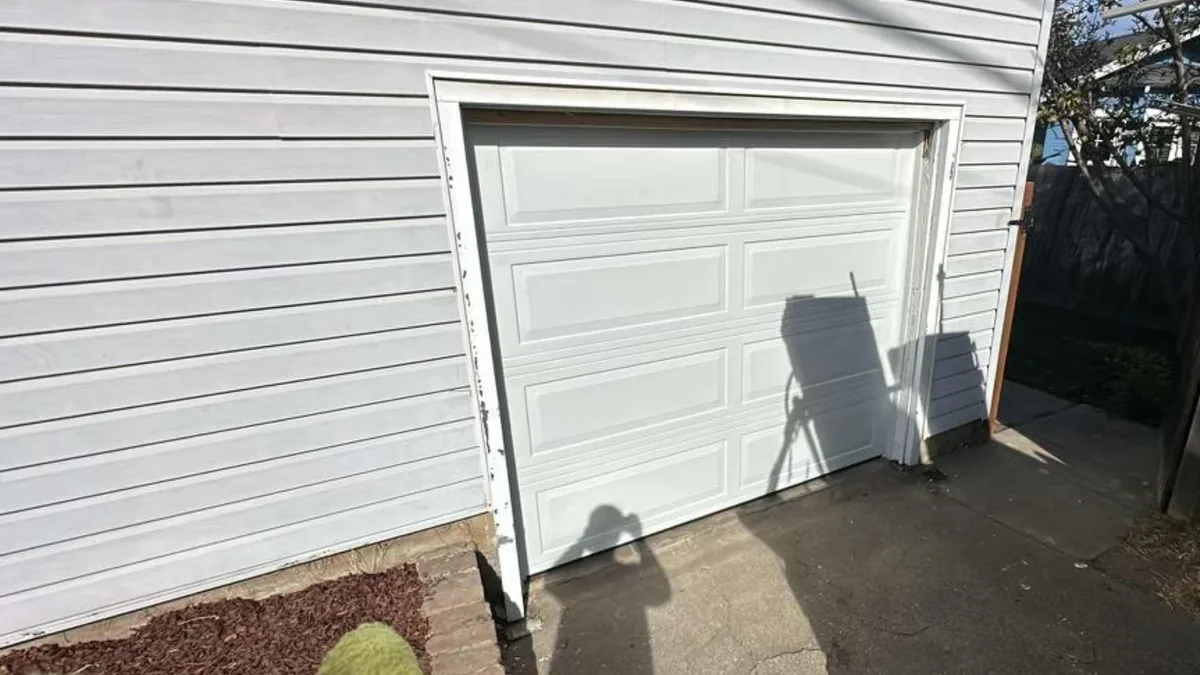
An alignment problem leaves the track straight but puts it in the wrong place. The door may bind only when it is partway up, or only in the last foot of closing, or it may rub lightly along one side the whole way. The track can be pushed out of position by a loose bracket, by the door hitting something, or simply by the fasteners working loose over time. From outside the door, the clue is usually that the door does not sit evenly in its opening, or that the gap along one side is different from the gap along the other. The technician confirms alignment by measuring the track's position relative to the door and to the other track.
This is also where a crooked door earns a caution. A door that hangs at an angle in the closed position can mean a snapped cable, a broken spring, or a bent track, and the three are separated by a technician, not by the homeowner. Do not try to sort that out by hand.
What you can check, and what you should not
The safe checks are visual and done with the door closed and the garage empty. Stand back and note whether the door sits level with the floor across its width. Note whether the door feels heavier than usual when you use it normally, and whether a new noise has appeared at the start of a cycle. Write down what you see and when it happens.
Everything past that belongs to a technician. Do not loosen track brackets, do not try to straighten a track by hand, and do not pull the emergency release to move the door manually. The track is under load from the door and the springs, and a bracket that lets go while you are working on it can bring the door down. The technician inspects the springs, cables, rollers, and hinges as part of the same visit, because a bent track is often one part of a larger picture.
Why it matters on the Treasure Coast
Doors in this region take a particular kind of punishment. Storm-season wind loads push on the door and the tracks, and a door that has been stressed by wind may show a bend that was not there before the last storm. Salt air and humidity also work on fasteners and brackets, and a bracket that has corroded can let the track shift out of alignment without any visible bend at all. That is one reason a track problem here is worth having looked at rather than worked around. If the door is binding, scraping, or sitting crooked, call DoorCore Garage Doors at (561) 421-5760 or email DoorCoreFL@gmail.com. The company serves Port St. Lucie, Fort Pierce, Stuart, Jensen Beach, Palm City, Hobe Sound, Vero Beach, and Sebastian, is licensed and insured, and offers emergency service. Weekday hours are 7:00 AM to 7:00 PM, Saturday 8:00 AM to 5:00 PM.